Adult spinal deformity (ASD) is a condition that affects the alignment and curvature of the spine in adulthood. It can lead to chronic back pain, poor posture, reduced mobility, nerve-related symptoms, and a significant decline in quality of life. While some deformities develop as part of the ageing process, others arise from conditions that have been present since childhood or develop following injury, degeneration, or previous surgery.
Many people assume that spinal deformities only affect children or teenagers. However, adult spinal deformity is becoming increasingly common as people live longer and remain active later in life. Advances in diagnostic imaging, surgical planning, navigation, and robotic-assisted surgery have transformed the way these conditions are treated, allowing many patients to regain mobility, reduce pain, and improve their overall quality of life.
At Spine Focus, Mr. Desmond Sanusi specialises in the assessment and treatment of complex spinal conditions, including adult spinal deformities, complex spine pathologies, craniocervical pathologies, and degenerative disorders.
What Is Adult Spinal Deformity?
Adult spinal deformity refers to an abnormal curvature, alignment, or balance of the spine that develops or persists during adulthood. The condition can affect the spine in multiple directions and may involve one or several spinal regions.
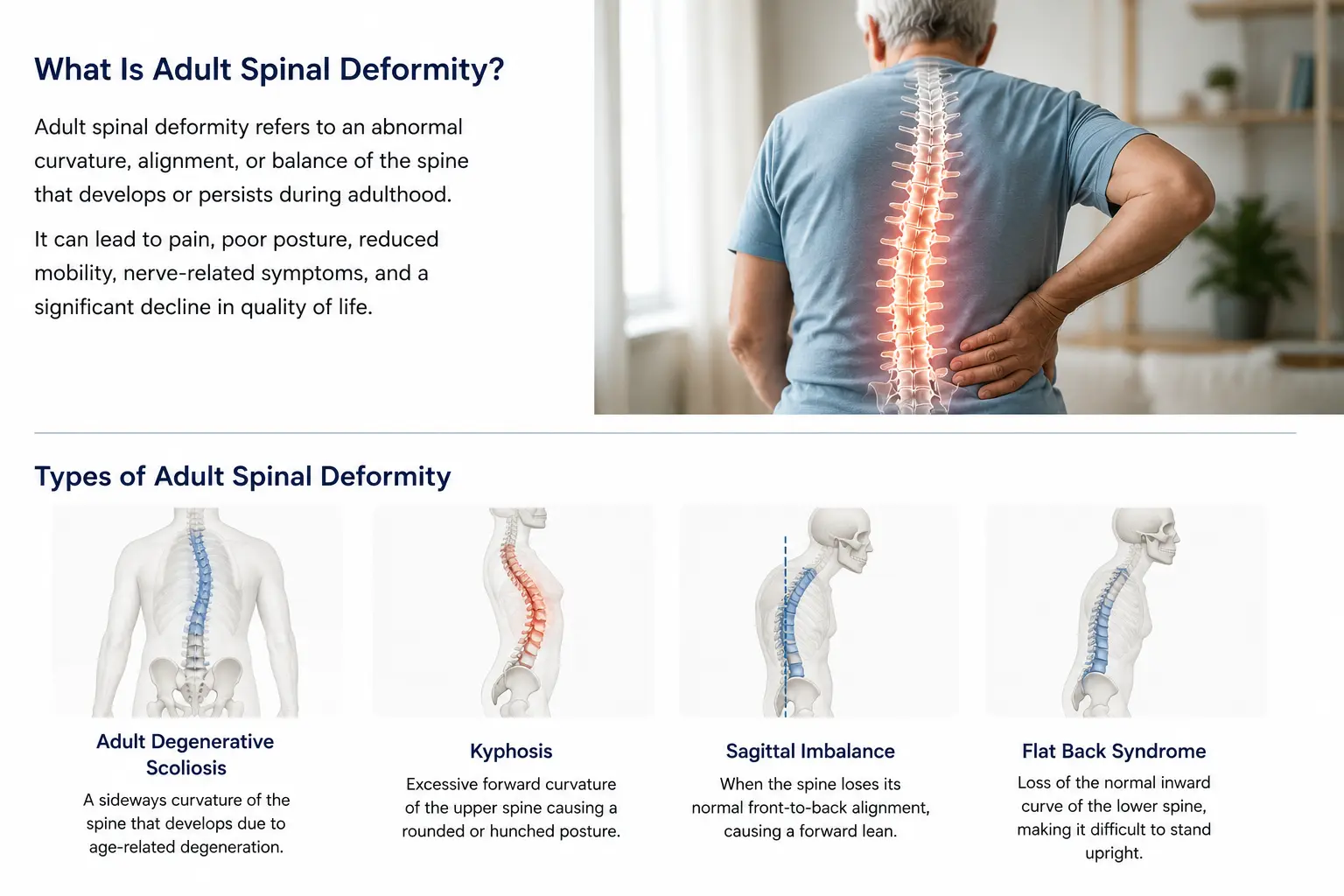
In a healthy spine, there are natural curves that help distribute weight evenly and maintain balance. When these curves become exaggerated, reduced, or misaligned, patients may experience pain, difficulty standing upright, fatigue, and reduced function.
This condition is not simply a cosmetic issue. As spinal alignment changes, the body must work harder to maintain balance. Over time, this can place excessive strain on muscles, joints, discs, and nerves, leading to progressive symptoms and disability.
Types of Adult Spinal Deformity
Adult Degenerative Scoliosis
Adult degenerative scoliosis is one of the most common forms of this condition. It develops when age-related degeneration affects the discs and joints of the spine, causing the spine to curve sideways.
Kyphosis
Kyphosis refers to an excessive forward curvature of the upper spine. Patients may develop a rounded or hunched appearance and often struggle to maintain an upright posture.
Sagittal Imbalance
Sagittal imbalance occurs when the spine loses its normal front-to-back alignment. Patients often describe feeling as though they are leaning forward when standing or walking.
Flat Back Syndrome
Flat back syndrome develops when the normal inward curve of the lower spine is reduced or lost. This can make standing upright difficult and may result in significant pain and functional limitations.
What Causes Adult Spinal Deformity?
Some patients develop adult spinal deformity as a result of congenital conditions affecting the spine and skull base. These conditions may require specialist assessment of craniocervical pathologies to determine the most appropriate treatment approach.
- Age-related degeneration of spinal discs and joints
- Adult scoliosis
- Osteoporosis and vertebral fractures
- Previous spinal surgery
- Congenital spinal abnormalities
- Neuromuscular disorders
- Trauma and spine injuries
- Inflammatory spine conditions
Symptoms of Adult Spinal Deformity
In some cases, spine deformity may contribute to spinal cord compression and symptoms associated with cervical myelopathy or other complex neurological conditions requiring specialist evaluation.
- Persistent back pain
- Neck pain
- Changes in posture
- Difficulty standing upright
- Leg pain or sciatica
- Numbness and tingling
- Muscle weakness
- Reduced walking distance
- Loss of balance
- Difficulty performing daily activities
How Is Adult Spinal Deformity Diagnosed?
Diagnosis begins with a detailed medical history and physical examination. Imaging studies such as standing X-rays, MRI scans, CT scans, and bone density assessments help determine the severity of the condition and guide treatment planning.
Can It Be Treated Without Surgery?
Yes. Many patients can be managed successfully without surgery, particularly during the early stages. The primary goals are to reduce pain, improve mobility, maintain function, and slow progression where possible.
Physiotherapy
Targeted exercises can strengthen core muscles, improve flexibility, enhance posture, and support overall back health.
Pain Management
Medication and other conservative therapies may help control pain and inflammation, allowing patients to remain active.
Targeted Injections
Image-guided injections can provide relief from symptoms caused by nerve irritation or compression.
Weight Management and Bone Health
Maintaining a healthy weight and addressing osteoporosis can reduce strain on the back and help limit further progression.
When Is Surgery Recommended?
Surgery may be considered when symptoms significantly affect quality of life, conservative treatments no longer provide adequate relief, or there is worsening curvature, nerve compression, instability, or loss of balance.
Surgical Treatment Options
When non-surgical treatments are no longer effective, surgery may be recommended to relieve pain, restore alignment, improve posture, and protect neurological function.
The most appropriate procedure depends on the severity of the condition, the patient’s symptoms, overall health, and treatment goals.
Decompression Surgery
Many patients also develop spinal stenosis, where narrowing around the nerves causes pain, numbness, tingling, or weakness.
Decompression surgery removes the structures responsible for this pressure and can significantly improve symptoms.
Fusion Surgery
Fusion is commonly performed to stabilise affected vertebrae and prevent abnormal movement. During the procedure, two or more vertebrae are joined together using bone grafts and specialised implants.
This can improve stability and help maintain correction over the long term.
Corrective Reconstruction
Patients with significant postural imbalance may require more complex reconstructive procedures designed to restore alignment and improve function.
These operations can enhance mobility, reduce pain, improve posture, and support a better quality of life.
Minimally Invasive Spine Surgery
Where appropriate, minimally invasive surgical techniques may be used to reduce muscle disruption, minimise blood loss, and support a faster recovery.
Not every patient is suitable for minimally invasive surgery, but these techniques continue to play an increasingly important role in modern spinal care.
How Navigation and Robotic Technology Are Changing Spine Surgery
One of the most significant advances in modern spine surgery is the development of navigation systems and robotic-assisted technology.
These innovations allow surgeons to visualise anatomy in real time, plan procedures with greater accuracy, and place implants with exceptional precision.
Advanced navigation systems act like a GPS for the spine, helping surgeons identify critical anatomical structures and improve implant placement accuracy.
Robotic-assisted surgery can further enhance precision by helping surgeons execute pre-planned surgical trajectories while maintaining complete surgical control.
These technologies are particularly valuable when treating complex conditions where anatomy may be distorted or unusual.
Mr. Desmond Sanusi’s Published Research in Advanced Spine Surgery
Mr. Desmond Sanusi is committed to evidence-based spinal care and actively contributes to advances in surgery through research and clinical practice.
In a recent peer-reviewed publication, Mr. Sanusi co-authored a study published in the Journal of Neurosurgery: Case Lessons entitled:
“Robot- and navigation-assisted cervical fusion and decompression for complex vertebral artery anomalies in os odontoideum with Klippel-Feil syndrome: illustrative case.”
The publication described the successful treatment of a patient with highly complex cervical spine anatomy and significant vertebral artery abnormalities.
The publication demonstrates how advances in robotic and minimally invasive surgery and modern navigation systems are helping surgeons safely manage highly complex conditions.
Using advanced navigation and robotic-assisted technology, the surgical team was able to carefully plan and perform the procedure while accounting for challenging anatomical variations.
The study demonstrates how modern technologies can improve surgical precision and safety when managing complex disorders.
Although not every patient with adult spinal deformity requires robotic-assisted surgery, the principles demonstrated in this research highlight the importance of detailed surgical planning, advanced imaging, and precision-guided techniques in modern spine care.
How Mr. Desmond Sanusi Treats Adult Spinal Deformity
At Spine Focus, Mr. Desmond Sanusi takes a personalised approach to the management of adult spinal deformity.
Every patient undergoes a comprehensive assessment that includes a detailed medical history, physical examination, neurological evaluation, and advanced imaging studies where required.
The primary goal is to identify the underlying cause of symptoms and determine the most appropriate treatment strategy.
Depending on the underlying diagnosis, treatment may involve conservative management, endoscopic spine surgery, treatment of complex spine pathologies, or advanced robotic-assisted spinal surgery.
Many patients can achieve meaningful improvement without surgery through a combination of:
- Physiotherapy
- Pain management strategies
- Lifestyle modifications
- Targeted injections
- Bone health optimisation
When surgery is required, treatment recommendations are tailored to the individual’s symptoms, spinal alignment, neurological findings, lifestyle requirements, and overall health.
Where appropriate, modern technologies such as navigation and robotic-assisted techniques may be incorporated into surgical planning and treatment.
The focus is always on achieving the safest and most effective outcome while helping patients regain mobility, independence, and quality of life.
Why Choose Spine Focus for Adult Spinal Deformity Treatment?
Spine Focus provides specialist assessment and treatment for a wide range of spinal conditions, including:
- Adult spinal deformity
- Adult scoliosis
- Spinal stenosis
- Cervical myelopathy
- Degenerative disc disease
- Sciatica
- Neck pain
- Back pain
- Complex spine disorders
Patients benefit from an evidence-based approach that combines clinical expertise, advanced diagnostics, modern surgical techniques, and personalised treatment planning.
At Spine Focus, treatment is centred around the individual patient, ensuring that every decision is guided by clinical need, patient goals, and long-term outcomes.
Recovery After Adult Spinal Deformity Surgery
Recovery varies depending on the complexity of the procedure, the patient’s general health, and the severity of the deformity.
Most patients follow a structured rehabilitation programme designed to support healing and maximise recovery.
Recovery may include:
- Early mobilisation
- Physiotherapy
- Pain management
- Gradual return to daily activities
- Regular follow-up appointments
Many patients experience substantial improvements in pain, posture, mobility, and overall function following successful treatment.
Recovery is a gradual process, and outcomes continue to improve over several months following surgery.
Can Adult Spinal Deformity Be Prevented?
While not all cases can be prevented, maintaining good spinal health may help reduce the risk of progression.
- Maintain a healthy weight
- Stay physically active
- Avoid smoking
- Manage osteoporosis
- Maintain good posture
- Seek early assessment for persistent spinal symptoms
Early diagnosis and intervention often provide the best opportunity to preserve function and prevent worsening deformity.
When Should You See a Spine Specialist?
You should seek specialist assessment if you experience:
- Persistent back pain
- Chronic neck pain
- Visible changes in posture
- Progressive spinal curvature
- Difficulty standing upright
- Numbness or weakness in the arms or legs
- Balance problems
- Reduced walking distance
Early assessment can help identify the underlying cause of symptoms and ensure that appropriate treatment is started as soon as possible.
Conclusion
Adult spinal deformity can have a significant impact on posture, mobility, independence, and overall quality of life. Fortunately, advances in diagnostics, rehabilitation, minimally invasive procedures, navigation systems, and robotic technology have greatly expanded the treatment options available to patients.
Individuals experiencing persistent back or neck pain, changes in posture, balance problems, or reduced mobility may benefit from specialist assessment at Spine Focus. Treatment options range from physiotherapy and pain management to endoscopic techniques and robotic-assisted surgery where appropriate.
At Spine Focus, Mr. Desmond Sanusi provides comprehensive assessment and personalised care for adults with complex back and neck conditions. Whether treatment involves conservative therapies, targeted injections, or advanced surgical procedures, the goal is always to reduce pain, restore function, and help patients return to the activities that matter most.
References
- Maragkos GA, Sanusi D, Ilyas A, et al. Robot- and navigation-assisted cervical fusion and decompression for complex vertebral artery anomalies in os odontoideum with Klippel-Feil syndrome: illustrative case. Journal of Neurosurgery: Case Lessons. 2025.
- Ames CP, Smith JS, Scheer JK, et al. Impact of spinopelvic alignment on decision-making in adult spinal deformity.
- Schwab F, Dubey A, Gamez L, et al. Adult scoliosis: prevalence and impact on quality of life. Spine.
Related Articles:
- Walking After Endoscopic Spine Surgery
- Endoscopic Spine Surgery Recovery Time
- Understanding Chiari Malformation
Frequently Asked Questions
What is adult spinal deformity?
Adult spinal deformity refers to abnormal alignment or curvature that develops or persists during adulthood. Common examples include adult scoliosis, kyphosis, and sagittal imbalance.
How does Mr. Desmond Sanusi treat this deformity?
Mr. Desmond Sanusi provides personalised treatment for adult spinal deformity at Spine Focus. Depending on the severity of the condition, treatment may include physiotherapy, pain management, spinal injections, minimally invasive procedures, or complex surgery using advanced navigation and robotic-assisted technologies where appropriate.
Can adult spinal deformity get worse over time?
Yes. Many forms of this conditions are progressive and may worsen if left untreated.
Is surgery always necessary?
No. Many patients can be successfully managed with physiotherapy, pain management, injections, and lifestyle modifications.
What are the symptoms of adult spinal deformity?
Common symptoms include back pain, neck pain, poor posture, difficulty standing upright, sciatica, numbness, weakness, and reduced mobility.
Can adult scoliosis be treated without surgery?
Yes. Many patients with adult scoliosis can achieve symptom relief through non-surgical treatments.
What is robotic-assisted spine surgery?
Robotic-assisted surgery uses advanced technology to assist surgeons with planning and implant placement, improving precision during complex procedures.
How long does recovery take after surgery?
Recovery varies depending on the procedure performed but often continues for several months after surgery.
When should I seek specialist advice?
You should seek assessment if you experience persistent spine pain, posture changes, neurological symptoms, or reduced mobility.