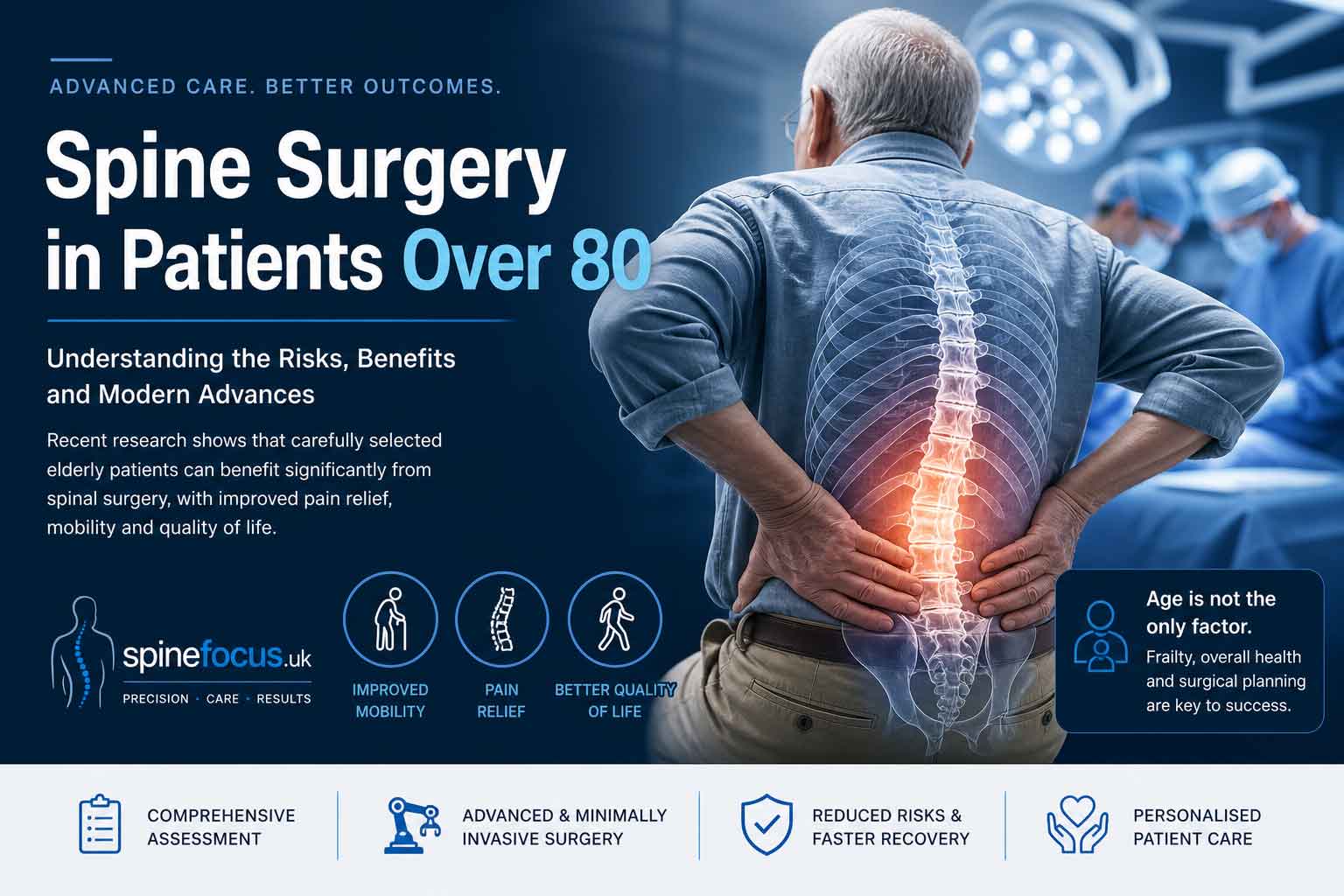
As people live longer and remain active later in life, spinal conditions are becoming increasingly common in adults over 80. Problems such as spinal stenosis, degenerative disc disease, spinal fractures, nerve compression, and arthritis of the spine can significantly affect mobility, independence, and quality of life.
Many elderly patients and their families worry that they may be “too old” for spinal surgery. However, modern advances in spinal care, minimally invasive surgery, anaesthesia, and rehabilitation have changed the way spinal conditions are treated in older adults.
At Spinefocus UK London, Mr. Desmond Sanusi, Consultant Neurosurgeon and Complex Spine Surgeon, provides specialist assessment and personalised treatment for patients with both routine and complex spinal disorders, including elderly and higher-risk patients.
Why Spinal Problems Are Common After 80
The spine naturally changes with age. Over time, spinal discs lose hydration, joints become arthritic, and the spinal canal may narrow. These age-related changes can place pressure on nerves and affect movement, balance, and strength.
Many elderly patients experience:
- Chronic lower back pain
- Leg pain and sciatica
- Difficulty walking long distances
- Weakness or numbness in the legs
- Balance problems and falls
- Neck pain and stiffness
- Loss of mobility and independence
For some patients, symptoms become severe enough to interfere with everyday activities such as walking, climbing stairs, shopping, or even standing comfortably.
While physiotherapy, medication, injections, and pain management can often help, surgery may sometimes become necessary when symptoms continue to worsen.
Can Patients Over 80 Safely Have Spine Surgery?
One of the biggest myths surrounding spine surgery is that advanced age automatically makes surgery unsafe. Modern research suggests this is not always true.
Recent studies evaluating spinal surgery outcomes in patients aged over 80 found that carefully selected elderly patients can still experience meaningful improvement after surgery. Many patients reported:
- Reduced back and leg pain
- Improved walking ability
- Better balance and mobility
- Improved independence
- Enhanced overall quality of life
The key factor is not simply age itself, but the patient’s overall health, mobility, frailty level, and surgical planning.
At Spinefocus London, Mr. Sanusi carefully evaluates every patient individually to determine the safest and most effective treatment pathway.
Frailty Is Often More Important Than Age
Modern spinal specialists now understand that two people of the same age may have very different levels of health and fitness.
An active and independent 85-year-old may recover better than a younger patient with severe frailty or multiple uncontrolled medical conditions.
For this reason, elderly spinal assessments often focus on:
- Frailty and fitness levels
- Heart and lung function
- Walking ability and mobility
- Bone quality
- Neurological symptoms
- Nutrition and recovery potential
- Patient goals and expectations
Mr. Desmond believes treatment decisions should always be personalised, balancing symptom severity, quality of life, and surgical risk.
Minimally Invasive Spine Surgery in Elderly Patients
Advances in minimally invasive spinal surgery are helping many elderly patients recover faster with reduced tissue damage and shorter hospital stays.
Compared with traditional open surgery, minimally invasive spine surgery may offer:
- Smaller incisions
- Less muscle damage
- Reduced blood loss
- Lower infection risk
- Less postoperative pain
- Faster rehabilitation
- Shorter recovery time
In selected patients, robotic-assisted spinal surgery and endoscopic spine surgery may further improve precision and safety.
At Spinefocus UK, advanced surgical planning and evidence-based techniques are used to improve outcomes while minimising complications.
What Spinal Conditions Commonly Affect Elderly Patients?
Several spinal conditions may require specialist assessment or surgery in patients over 80, including:
- Lumbar spinal stenosis
- Degenerative disc disease
- Cervical myelopathy
- Spondylolisthesis
- Vertebral compression fractures
- Spinal instability
- Nerve compression syndromes
- Spinal tumours
Symptoms such as worsening weakness, walking difficulties, severe pain, or loss of balance should never simply be dismissed as “normal ageing.”
Signs It May Be Time to See a Spine Specialist
Elderly patients should consider seeking specialist spinal assessment if they experience:
- Progressive walking difficulties
- Severe lower back or neck pain
- Difficulty standing upright
- Frequent falls or instability
- Weakness in the arms or legs
- Numbness or tingling
- Loss of independence
- Reduced quality of life
Early assessment may help identify treatment options before symptoms become more severe or disabling.
Specialist Spine Care at Spinefocus London
Spinefocus provides advanced spinal assessment and treatment for patients across London and the UK.
Mr. Desmond Sanusi is a Consultant Neurosurgeon and Complex Spine Surgeon with specialist fellowship training in minimally invasive, robotic-assisted, and complex spinal surgery.
The practice focuses on patient-centred care, evidence-based treatment, and tailored surgical planning designed to improve long-term mobility, comfort, and independence.
Conclusion
Being over 80 does not automatically prevent someone from benefiting from spinal surgery. With modern techniques, careful patient selection, and specialist spinal care, many elderly patients can safely undergo treatment and achieve meaningful improvements in pain, mobility, and quality of life.
If spinal symptoms are affecting everyday activities, walking ability, or independence, seeking specialist assessment may help identify suitable treatment options.
At Spinefocus UK London, Mr. Sanusi provides comprehensive spinal assessment and personalised care for elderly patients with both routine and complex spinal conditions.
Research Reference
Reference: Research findings and study details sourced from the published cohort study on spinal surgery outcomes in patients aged 80 years and above.
Frequently Asked Questions
Is spine surgery safe for people over 80?
Yes, spine surgery can be safe for carefully selected patients over 80. Modern surgical techniques, improved anaesthesia, minimally invasive procedures, and better postoperative care have significantly improved safety and recovery outcomes in elderly patients.
Can elderly patients recover well after spinal surgery?
Many elderly patients experience meaningful improvement in pain, mobility, walking ability, and overall quality of life after spinal surgery. Recovery depends on overall health, frailty level, fitness, and the complexity of the procedure.
What spinal conditions commonly affect elderly patients?
Common spinal conditions in older adults include lumbar spinal stenosis, degenerative disc disease, cervical myelopathy, vertebral fractures, nerve compression, and spinal instability.
Is age alone a reason to avoid spine surgery?
No. Modern research shows that frailty, general health, and mobility are often more important than age itself when assessing surgical suitability.
What are the benefits of minimally invasive spine surgery for elderly patients?
Minimally invasive spine surgery may offer smaller incisions, reduced blood loss, lower infection risk, less muscle damage, shorter hospital stays, and faster recovery compared with traditional open surgery.
When should an elderly patient see a spine specialist?
Patients should seek specialist assessment if they experience worsening back or neck pain, walking difficulties, weakness, numbness, balance problems, or loss of independence.
Does Spinefocus London treat elderly spinal patients?
Yes. Spinefocus UK London provides specialist assessment and treatment for elderly patients with both routine and complex spinal conditions.
Who is Mr. Desmond Sanusi?
Mr. Desmond Sanusi is a Consultant Neurosurgeon and Complex Spine Surgeon with specialist fellowship training in minimally invasive, robotic-assisted, and advanced spinal surgery techniques.