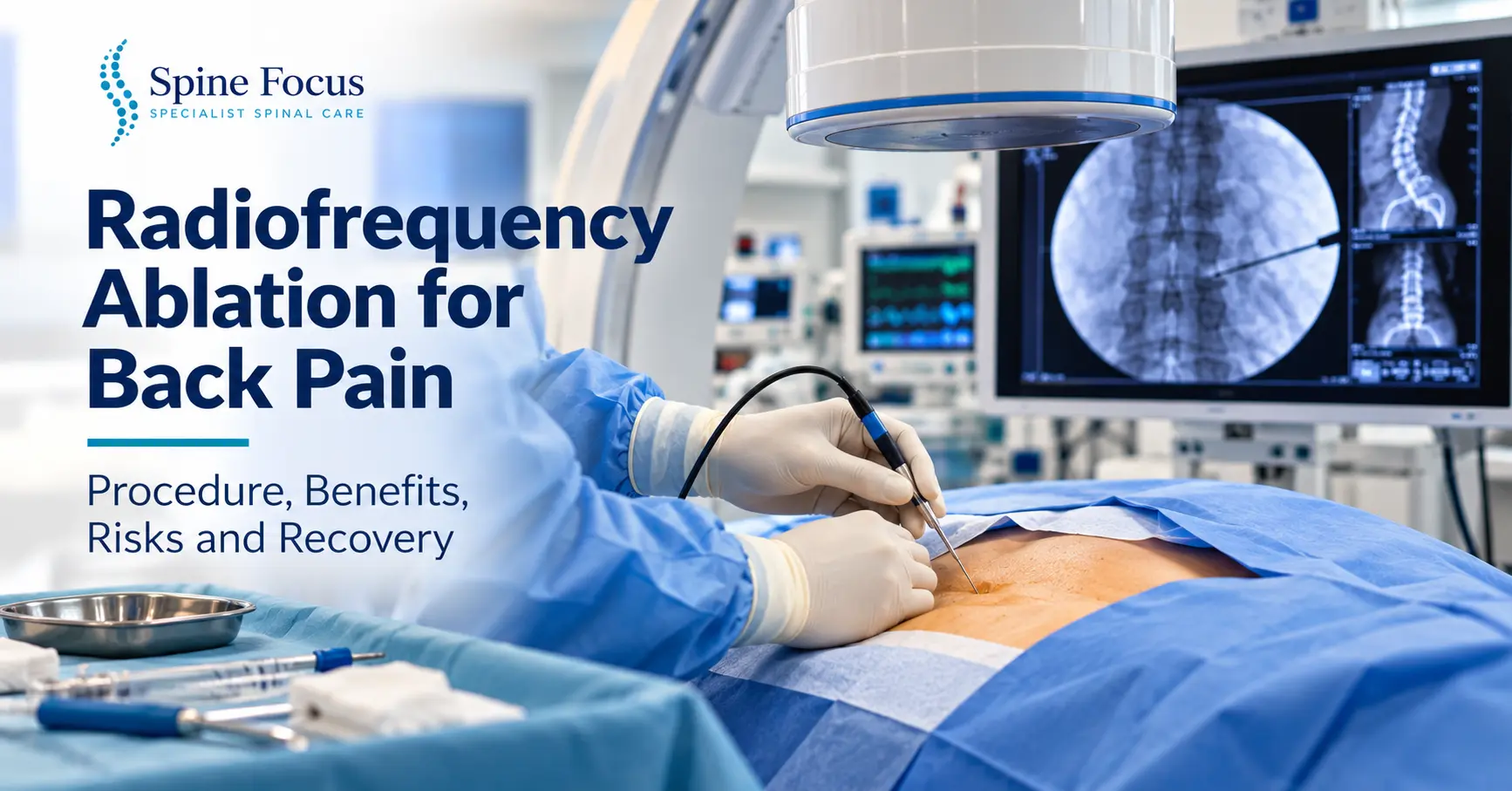
Back pain can affect almost every part of daily life, from sitting at a desk and sleeping comfortably to walking, working and spending time with family. While many people improve with non-surgical treatment, persistent back pain sometimes requires a more targeted approach.
Radiofrequency ablation (RFA) is a minimally invasive procedure that uses controlled heat to interrupt pain signals carried by specific nerves. It may help selected people with long-lasting back pain, particularly when the pain is thought to come from the small joints at the back of the spine.
But is radiofrequency ablation right for everyone? How does the procedure work, how long can the results last, and what should you expect during recovery?
In this guide, Spine Focus explains radiofrequency ablation for back pain, including how it works, who may benefit, its potential advantages and risks, and when to seek specialist advice.
What Is Radiofrequency Ablation for Back Pain?
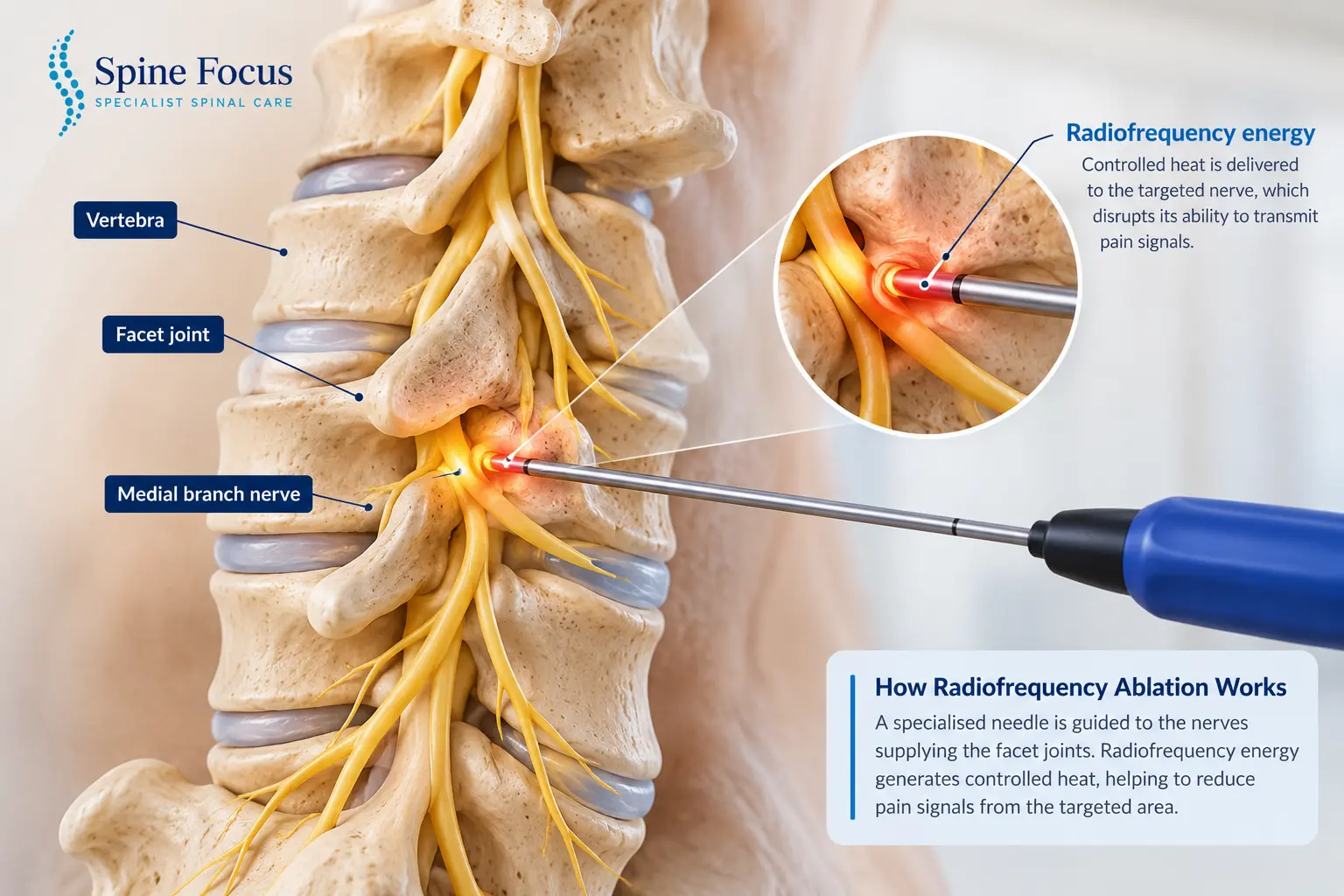
Radiofrequency ablation is a procedure that uses radiofrequency energy to generate controlled heat around a targeted nerve. This disrupts the nerve’s ability to transmit pain signals from a particular area of the body.
When used for certain types of back pain, the procedure is often called radiofrequency denervation.
It is most commonly considered for persistent pain arising from the facet joints — the small joints that connect the bones of the spine and help guide movement.
These joints can become painful due to wear and tear or other changes affecting the spine. When appropriate non-surgical treatments have not provided sufficient relief, radiofrequency denervation may be considered as another treatment option.
The aim is to reduce pain and help improve everyday activities. However, results vary, and the procedure does not correct every underlying spinal problem.
Radiofrequency ablation is not the same as spinal surgery. It generally involves passing a specialised needle through the skin towards the nerves being treated, using imaging guidance to help position it accurately.
How Does Radiofrequency Ablation Work?
The spine contains many nerves that carry information between the body and the brain. Some of these nerves transmit pain signals from the joints and other structures around the spine.
During radiofrequency ablation, a clinician guides a specialised needle towards the selected nerve using imaging, usually X-ray guidance. Radiofrequency energy then produces controlled heat at the treatment site.
This affects the targeted nerve’s ability to transmit pain signals. The aim is to reduce pain from the structure supplied by that nerve.
The procedure does not remove a disc, straighten the spine or repair damaged joints. Instead, it targets a particular part of the pain-signalling pathway.
What Areas of the Spine Can Be Treated?
Radiofrequency procedures may be used for selected pain conditions involving different areas of the spine, depending on the nerves being targeted and the patient’s diagnosis.
For lower back pain, treatment commonly focuses on the nerves supplying the lumbar facet joints. Related procedures may also be considered for selected cases of neck pain arising from cervical facet joints.
The important point is that the source of the pain must be assessed carefully. Back pain can arise from muscles, discs, joints, nerves and other structures, and radiofrequency ablation is not suitable for all of them.
Which Types of Back Pain May Respond to Radiofrequency Ablation?
Not all back pain has the same cause. Identifying the likely source of the pain is an important part of deciding which treatment may help.
Radiofrequency denervation may be considered when persistent pain is thought to originate from the facet joints of the spine.
Facet Joint Pain
Facet joints help connect neighbouring vertebrae and guide spinal movement. Changes affecting these joints may contribute to persistent pain in some people.
Symptoms can include localised back or neck discomfort and pain that becomes more noticeable with certain movements. However, symptoms alone cannot reliably confirm that the facet joints are responsible.
Chronic Lower Back Pain
Some people experience lower back pain that continues for months despite appropriate non-surgical treatment. If a specialist suspects that the pain originates from the facet joints, further assessment may help determine whether radiofrequency denervation is appropriate.
Selected Cases of Neck Pain
Similar procedures can sometimes be used for persistent neck pain associated with the cervical facet joints. The assessment and treatment approach depend on the location of the pain and the patient’s individual circumstances.
When Radiofrequency Ablation May Not Help
Radiofrequency ablation is not a universal treatment for back pain. It may not be appropriate when symptoms are primarily caused by a herniated disc, significant nerve compression, spinal instability, infection or another condition requiring a different approach.
For example, pain travelling down the leg due to sciatica may have a different cause from pain arising from the facet joints.
A specialist assessment is therefore essential before deciding whether this procedure is suitable.
Who May Be Suitable for Radiofrequency Ablation?
Radiofrequency ablation is generally considered for carefully selected patients rather than as a first treatment for every episode of back pain.
A specialist may consider the procedure when:
- Back pain has persisted despite appropriate non-surgical treatment.
- The pain is moderate or severe and affects everyday activities.
- The symptoms and clinical assessment suggest that the facet joints may be the source of the pain.
- Other possible causes have been considered.
- Diagnostic nerve blocks indicate that targeting the relevant nerves may help.
UK guidance from the National Institute for Health and Care Excellence (NICE) recommends considering referral for radiofrequency denervation assessment in selected people with chronic lower back pain when non-surgical treatment has not worked, the pain is thought to arise from structures supplied by the medial branch nerves, and the pain is sufficiently severe.
NICE also recommends that radiofrequency denervation should only be performed after a positive response to a diagnostic medial branch block.
What Is a Diagnostic Medial Branch Block?
A diagnostic medial branch block involves injecting a small amount of local anaesthetic near the nerves that carry pain signals from the facet joints.
The clinician then assesses whether the injection provides meaningful temporary pain relief.
If the response supports the suspected source of pain, radiofrequency denervation may be considered. The precise assessment process depends on the clinical circumstances and the specialist’s approach.
A positive diagnostic block does not guarantee that radiofrequency ablation will provide lasting relief. It is one part of deciding whether the procedure is appropriate.
What Happens Before Radiofrequency Ablation?
Before treatment, a specialist will review your symptoms, medical history and previous treatments.
The assessment may include questions about:
- Where the pain is located and how long it has been present.
- Whether pain spreads into the buttocks or legs.
- Which movements or activities make the pain better or worse.
- How the pain affects sleep, work and daily activities.
- What treatments you have already tried and how well they worked.
A physical examination may also be performed. Imaging may be considered when clinically appropriate to investigate possible causes of the symptoms, although an MRI or other scan does not always identify the exact source of facet joint pain.
Your clinician will explain the intended benefits, potential risks and available alternatives.
You should tell the clinical team about any medicines you take, allergies, bleeding problems, infections or other relevant medical conditions. Do not stop prescribed medication unless your treating team advises you to do so.
If the procedure is considered appropriate, you will receive instructions about preparation, eating and drinking, medication and arrangements for travelling home.
What Happens During the Procedure?
Radiofrequency ablation is usually performed as a minimally invasive procedure, often with local anaesthetic. The exact process depends on the area being treated and the clinical technique used.
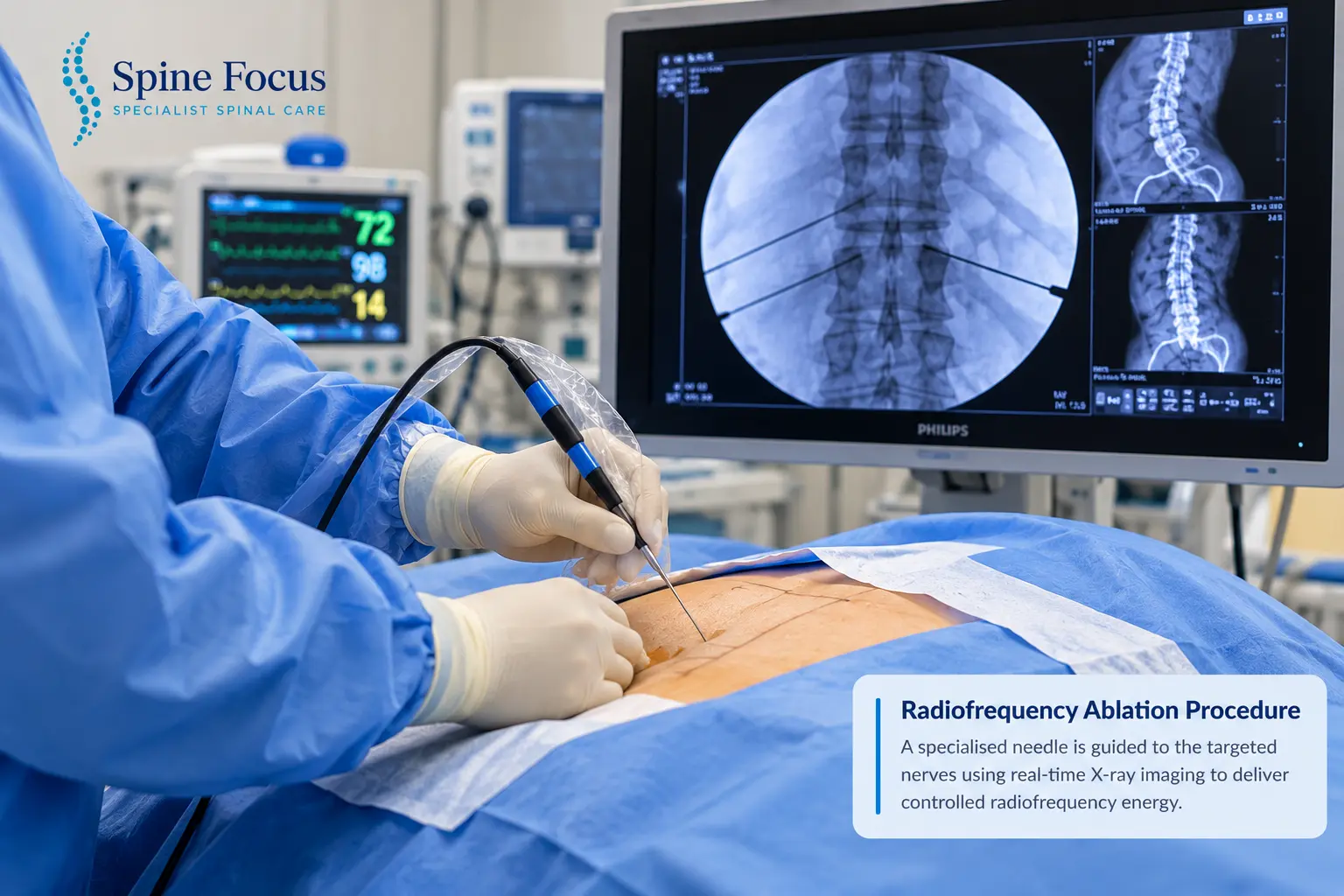
Although the details can vary, the procedure generally involves the following steps.
1. Positioning and Preparation
You will be positioned so that the clinician can safely access the targeted area of the spine. The skin is cleaned, and the treatment area is prepared using sterile equipment.
2. Local Anaesthetic
Local anaesthetic is used to numb the skin and the area where the needle will be inserted. You may feel some pressure or brief discomfort during this stage.
3. Needle Placement
Using imaging guidance, the clinician carefully positions a specialised needle near the targeted nerve.
The position is checked to help ensure that the treatment is delivered to the intended area.
4. Radiofrequency Treatment
Radiofrequency energy is delivered through the needle to generate controlled heat around the target nerve.
The clinician may perform checks during the procedure to help confirm the correct positioning before treatment.
5. Monitoring Afterwards
After the procedure, you will be monitored for a period determined by the clinical team. The team will provide instructions about pain relief, activity, wound care where relevant and when to seek medical advice.
Some people return home on the same day, depending on the procedure, their health and the treating team’s assessment.
Benefits of Radiofrequency Ablation for Back Pain
For appropriately selected patients, radiofrequency ablation may offer several potential benefits.

Targeted treatment: The procedure focuses on specific nerves associated with the suspected source of pain.
A minimally invasive approach: It generally does not require a large surgical incision or removal of spinal structures.
Potentially longer-lasting relief: In suitable patients, pain relief may last longer than the temporary effect of a local anaesthetic injection.
Improved everyday function: If pain decreases, some people may find it easier to move, sleep, work or participate in normal activities.
An alternative to consider before some surgical procedures: Depending on the diagnosis, radiofrequency denervation may form part of a non-surgical treatment plan.
However, these are potential benefits rather than guaranteed outcomes. Not everyone experiences significant pain relief, and the procedure may not address the underlying cause of symptoms.
What Are the Risks and Side Effects?
Radiofrequency ablation is generally considered a low-risk procedure when performed appropriately, but no medical procedure is completely risk-free.
Possible side effects include:
- Temporary soreness or tenderness around the treatment area.
- A temporary increase in pain after the procedure.
- Bruising or minor bleeding where the needle was inserted.
- Temporary numbness or altered sensation.
- Infection at the treatment site.
- Rare nerve-related complications, including weakness or persistent sensory changes.
The likelihood and nature of complications depend on the treatment site, the procedure performed and individual health factors.
Your clinician should explain the risks relevant to your circumstances before treatment.
When Should You Seek Medical Advice?
Contact your treating team if you develop increasing pain, redness, swelling, discharge or other signs of infection after the procedure.
Seek urgent medical assessment if you develop new or worsening leg weakness, significant new numbness, difficulty walking, loss of bladder or bowel control, or numbness around the groin or saddle area.
New bladder or bowel dysfunction, saddle-area numbness or rapidly progressing weakness can indicate a serious spinal problem and should not be assumed to be a normal side effect of treatment. Seek emergency care if these symptoms occur.
Radiofrequency Ablation Recovery Time and Aftercare
Recovery varies between patients. Many people experience temporary tenderness or soreness around the treated area, and discomfort may briefly increase before it settles.
Your clinician will provide instructions based on the procedure you have undergone.
In general, recovery advice may include:
- Taking it easy for the period recommended by your treating team.
- Returning to everyday activities gradually, as comfort allows.
- Following advice about pain relief and wound care.
- Avoiding strenuous activity until you have been advised that it is appropriate.
- Monitoring symptoms and reporting any unexpected changes.
Some people notice an improvement in pain relatively soon, while others take longer to experience the effects. Temporary soreness can make it difficult to judge the final result immediately.
Follow-up may be arranged to review your response to treatment and discuss whether further management is needed.
For more detailed guidance, see our supporting article: Radiofrequency Ablation Recovery Time: What to Expect.
How Long Does Radiofrequency Ablation Last?
One of the most common questions about radiofrequency ablation is how long the pain relief will last.
There is no single answer. Some people experience meaningful relief for several months or longer, while others experience limited benefit or find that their symptoms return sooner.
The result depends on several factors, including the underlying cause of pain, the nerves treated, the response to diagnostic blocks and individual differences in healing and nerve regeneration.
The nerves treated during radiofrequency ablation can gradually recover their ability to transmit pain signals. If the original pain returns, a specialist may assess whether repeating the procedure is appropriate.
Repeat treatment is not automatically necessary or suitable for everyone. The decision depends on the benefit achieved from the first procedure, the duration of relief, the current symptoms and the clinical assessment.
For more information, read our supporting article: How Long Does Radiofrequency Ablation Last for Back Pain?.
Radiofrequency Ablation vs Spinal Injections
Radiofrequency ablation and spinal injections are different procedures, although both may be considered in the management of selected spinal pain conditions.
A spinal injection delivers medication, such as local anaesthetic or a corticosteroid, to a particular area. The intended effect depends on the type of injection and the condition being treated.
Radiofrequency ablation uses controlled heat to disrupt the transmission of pain signals through selected nerves.
| Feature | Radiofrequency Ablation | Spinal Injections |
|---|---|---|
| Main approach | Uses radiofrequency energy to affect targeted nerves | Delivers medication to a selected area |
| Intended effect | May provide longer-lasting relief in selected pain conditions | Depends on the injection and its purpose |
| Suitability | Requires careful assessment of the suspected pain source | Depends on the diagnosis and type of injection |
| Duration of relief | Varies; may last months or longer in suitable patients | Varies according to the injection and individual response |
These treatments are not interchangeable. For example, NICE recommends against spinal injections for managing low back pain itself, while allowing consideration of epidural injections of local anaesthetic and steroid for acute and severe sciatica in appropriate patients.
The most suitable approach depends on the underlying diagnosis rather than simply choosing the procedure that sounds more advanced.
For a more detailed comparison, see our supporting article: Radiofrequency Ablation vs Steroid Injections for Back Pain.
Is Radiofrequency Ablation Painful?
It is understandable to feel anxious about a procedure involving needles near the spine.
Local anaesthetic is generally used to numb the skin and the area where the needle is inserted. You may experience pressure, brief discomfort or unusual sensations during treatment.
Afterwards, some people notice tenderness or a temporary increase in their usual pain. This usually settles, although recovery varies.
Your clinical team can explain what to expect and how discomfort will be managed during and after the procedure.
If you are worried about pain or have had a difficult experience with a previous injection or procedure, discuss this during your consultation.
Read more in our supporting article: Is Radiofrequency Ablation Painful? What Patients Should Know.
What Are the Alternatives to Radiofrequency Ablation?
Radiofrequency ablation is only one option within the wider management of back pain. Depending on the cause of symptoms, alternatives may include:
Exercise and physiotherapy: Appropriate movement and a tailored exercise programme may help improve strength, mobility and function.
Medication: A clinician may discuss suitable pain relief or other medication, taking into account your health and the potential benefits and risks.
Other pain-management approaches: The appropriate options depend on the diagnosis, previous treatments and the impact of symptoms on daily life.
Further investigation or specialist treatment: If symptoms suggest nerve compression, spinal instability or another structural problem, additional assessment may be needed.
Surgery: Surgery may be considered for certain spinal conditions when the expected benefits outweigh the risks and other appropriate treatments have not provided sufficient improvement.
There is no single treatment that is right for everyone. The aim is to identify the cause of pain and choose an approach that is appropriate for the individual.
When Should You Consult a Spine Specialist?
Consider seeking medical advice if back pain persists, repeatedly returns, interferes with everyday activities or does not improve with appropriate self-care.
A specialist assessment may be particularly helpful when symptoms are severe, the diagnosis is uncertain, or previous treatments have not provided sufficient relief.
You should not wait for a routine appointment if you develop warning signs such as new bladder or bowel dysfunction, numbness around the saddle area or rapidly progressing weakness. These symptoms require emergency assessment.
A spine specialist can review your symptoms, assess possible causes and explain whether conservative care, pain-management procedures, further investigations or surgery may be appropriate.
Radiofrequency Ablation at Spine Focus, London
Spine Focus provides specialist spinal and neurosurgical care led by Mr. Taofiq Desmond Sanusi, Consultant Neurosurgeon and Complex Spine Surgeon.
His clinical practice includes the assessment and treatment of complex spinal conditions, with expertise in minimally invasive, robotic-assisted and endoscopic spine surgery.
Radiofrequency ablation is listed among the services in Spine Focus’s practice information. Whether it is appropriate for an individual depends on the diagnosis, clinical assessment and the treatment options available.
The purpose of a specialist consultation is to understand your symptoms, identify the likely source of pain and discuss the most appropriate next steps.
If persistent back pain is affecting your quality of life, you can learn more about Spine Focus and its specialist services or request a consultation in London.
Explore our areas of expertise
References and Further Information
- NICE: Low back pain and sciatica in over 16s — recommendations
- Royal Orthopaedic Hospital: Radiofrequency denervation of nerves
- Guy’s and St Thomas’ NHS Foundation Trust: Radiofrequency denervation
This article is for general information and does not replace individual medical advice, diagnosis or treatment. Suitability for radiofrequency ablation should be assessed by an appropriately qualified clinician.
Frequently Asked Questions
Is radiofrequency ablation a permanent solution for back pain?
No. The procedure is not a guaranteed or permanent cure. Pain relief may last for months or longer in some patients, but the treated nerves can recover and symptoms may return.
Does radiofrequency ablation work for every type of back pain?
No. It is mainly considered for selected pain conditions where specific nerves are thought to be transmitting pain, particularly pain arising from the facet joints. It is not suitable for every cause of back pain.
How soon will I feel better after radiofrequency ablation?
The timing varies. Some people notice improvement relatively soon, while others take longer. Temporary soreness can occur after treatment, so the final response may not be clear immediately.
Can radiofrequency ablation be repeated?
It may be considered if the first procedure provided meaningful relief and the pain later returns. A specialist should reassess the symptoms and determine whether repeat treatment is appropriate.
Is radiofrequency ablation better than steroid injections?
Neither treatment is universally better. They have different purposes and are used for different clinical situations. The appropriate choice depends on the suspected source of pain and the individual’s assessment.
Do I need an MRI before radiofrequency ablation?
Not necessarily. Imaging may be useful when investigating certain spinal conditions, but NICE does not require imaging as a prerequisite for radiofrequency denervation for suspected facet joint pain. Clinical assessment and diagnostic medial branch blocks are important in determining suitability.
What are the most common side effects?
Temporary soreness, tenderness or a short-term increase in pain can occur. Bruising and other complications are possible, while serious nerve-related complications are rare. Your clinician should explain the risks relevant to your procedure.
Who should I contact if my pain gets worse after treatment?
Contact your treating team if pain is worsening or you have concerns about recovery. Seek urgent medical assessment for new or worsening weakness, significant new numbness, bladder or bowel dysfunction, or numbness around the saddle area.