Robotic and minimally invasive spinal surgery
Robotic and minimally invasive spinal surgery involves the use of advanced surgical technology and specialised techniques to treat spinal conditions with greater precision while minimising disruption to surrounding muscles, tissues, and nerves.
Modern minimally invasive spinal procedures use smaller incisions and highly specialised instruments to access the spine more precisely than traditional open surgery in selected patients. Robotic-assisted spinal surgery further enhances surgical planning and accuracy during complex spinal procedures.
These advanced techniques may be used to treat a wide range of spinal conditions including disc prolapse, spinal stenosis, degenerative spinal disease, spinal instability, deformity, and selected complex spinal disorders.
At Spine Focus UK, Mr. Taofiq Desmond Sanusi provides specialist assessment and advanced spinal treatment using modern minimally invasive and robotic-assisted surgical techniques where clinically appropriate.
Every patient undergoes comprehensive spinal evaluation and imaging assessment to determine the safest and most effective treatment strategy based on their symptoms, spinal pathology, neurological findings, and long-term recovery goals.
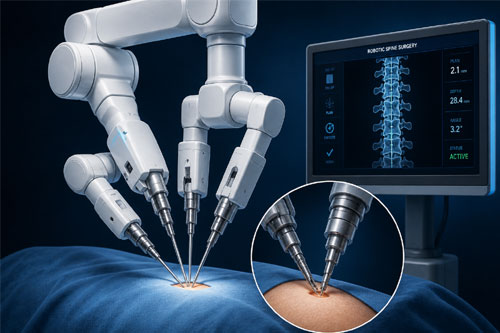
Understanding Robotic and Minimally Invasive Spinal Surgery
Advances in spinal surgery have led to the development of minimally invasive and robotic-assisted techniques designed to improve surgical precision while reducing tissue disruption.
Traditional open spinal surgery often requires larger incisions and greater muscle dissection to access the spine. In contrast, minimally invasive spinal surgery uses specialised instruments, tubular retractors, microscopes, and advanced imaging systems to treat spinal pathology through smaller incisions.
Robotic-assisted spinal surgery uses computer-guided technology and advanced surgical planning systems to improve precision during instrumentation placement and complex spinal procedures.
At Spine Focus UK, advanced spinal techniques are used as part of an evidence-based, patient-focused approach designed to optimise surgical outcomes, improve recovery, and minimise unnecessary tissue damage where appropriate.
What Conditions Can Be Treated?
Minimally invasive and robotic spinal techniques may be used to treat a wide range of spinal disorders.
Common conditions include:
- Disc prolapse
- Sciatica
- Spinal stenosis
- Degenerative disc disease
- Spondylolisthesis
- Nerve compression
- Spinal instability
- Degenerative scoliosis
- Selected spinal deformities
- Compression fractures
- Revision spinal surgery in selected cases
The suitability of minimally invasive or robotic-assisted surgery depends on the specific spinal condition, severity of symptoms, and overall spinal anatomy.
What Is Minimally Invasive Spinal Surgery?
Minimally invasive spinal surgery refers to techniques designed to access the spine using smaller incisions while minimising disruption to surrounding tissues.
Specialised surgical instruments and imaging guidance allow surgeons to perform spinal decompression, stabilisation, and fusion procedures with reduced muscle trauma.
Procedures may include:
- Microdiscectomy
- Minimally invasive decompression
- Tubular spinal surgery
- Minimally invasive spinal fusion
- Percutaneous instrumentation placement
- Endoscopic-assisted spinal procedures
These techniques are carefully selected based on patient anatomy and the underlying spinal pathology.
What Is Robotic-Assisted Spinal Surgery?
Robotic spinal surgery uses advanced computer-assisted systems to improve surgical planning and precision during spinal procedures.
Robotic technology allows detailed preoperative planning using advanced imaging and helps guide instrumentation placement with enhanced accuracy.
Robotic systems may assist with:
- Pedicle screw placement
- Spinal alignment planning
- Complex spinal reconstruction
- Deformity correction
- Multi-level spinal stabilisation
Robotic-assisted surgery does not replace the surgeon but acts as an advanced guidance tool to support surgical accuracy and consistency during complex procedures.
Potential Benefits of Minimally Invasive and Robotic Techniques
In carefully selected patients, modern minimally invasive and robotic techniques may provide several advantages compared with traditional open surgery.
Potential benefits may include:
- Smaller incisions
- Reduced muscle disruption
- Less postoperative pain
- Reduced blood loss
- Shorter hospital stays
- Lower infection risk in selected cases
- Earlier mobilisation
- Faster recovery
- Improved surgical precision
Recovery and outcomes vary depending on the complexity of the spinal condition and the procedure performed.
Who May Benefit From These Techniques?
Patients with selected spinal conditions who require surgical intervention may benefit from minimally invasive or robotic-assisted procedures.
These techniques may be considered for patients experiencing:
- Persistent back or neck pain
- Sciatica
- Nerve compression symptoms
- Progressive weakness
- Reduced mobility
- Spinal instability
- Degenerative spinal disease
- Symptoms not responding to conservative treatment
Comprehensive imaging and specialist spinal assessment are essential to determine the most appropriate surgical approach.
When Is Traditional Open Surgery Still Necessary?
Although minimally invasive and robotic-assisted surgery continue to expand treatment possibilities, some complex spinal conditions still require traditional open procedures.
Examples may include:
- Severe spinal deformity
- Complex revision surgery
- Advanced spinal tumours
- Extensive multi-level reconstruction
- Severe trauma
- Complex spinal instability
Treatment planning is always individualised to ensure the safest and most effective approach for each patient.
Recovery After Minimally Invasive and Robotic Spinal Surgery
Recovery depends on the type of spinal condition, surgical complexity, and overall patient health.
Many patients may experience:
- Earlier mobilisation
- Reduced postoperative discomfort
- Shorter hospital stays
- Gradual improvement in nerve symptoms
- Faster return to normal activities
Postoperative rehabilitation may include physiotherapy, guided exercises, and follow-up spinal assessment to support long-term recovery.
The Importance of Specialist Spinal Assessment
Not all patients or spinal conditions are suitable for minimally invasive or robotic-assisted surgery.
Careful specialist assessment helps determine:
- The exact spinal pathology
- The degree of nerve compression or instability
- The safest surgical technique
- The expected outcomes and recovery
- Whether minimally invasive treatment is appropriate
Detailed surgical planning and patient selection are essential to achieving optimal outcomes.
Advanced Robotic and Minimally Invasive Spine Surgery at Spine Focus UK
Spine Focus UK provides specialist diagnosis and advanced treatment for complex spinal disorders using modern minimally invasive and robotic-assisted spinal surgery techniques.
Mr. Taofiq Desmond Sanusi is a Consultant Neurosurgeon and Complex Spine Surgeon with advanced fellowship training in robotic spinal surgery, minimally invasive spinal techniques, endoscopic surgery, spinal deformity correction, and complex spinal pathology.
Patients receive comprehensive, evidence-based care using advanced imaging, modern surgical technologies, and personalised treatment planning focused on improving pain, neurological function, mobility, and long-term quality of life.
Frequently Asked Questions
Common questions about Robotic and minimally invasive spinal surgery, symptoms, diagnosis, treatment options, and recovery.
What is minimally invasive spinal surgery?
Minimally invasive spinal surgery uses smaller incisions and specialised instruments to treat spinal conditions while reducing disruption to surrounding muscles and tissues.
What is robotic-assisted spinal surgery?
Robotic spinal surgery uses advanced computer-guided technology to assist with surgical planning and improve precision during spinal procedures.
What conditions can be treated with minimally invasive spinal surgery?
Conditions may include disc prolapse, spinal stenosis, sciatica, nerve compression, degenerative spinal disease, and selected spinal instability disorders.
What are the benefits of minimally invasive spinal surgery?
Potential benefits include smaller incisions, reduced muscle damage, less pain, shorter hospital stays, reduced blood loss, and faster recovery.
Is robotic spinal surgery safer than traditional surgery?
Robotic technology may improve precision and surgical planning in selected procedures, but overall outcomes depend on the spinal condition, surgical complexity, and specialist expertise.
Who is suitable for robotic or minimally invasive spinal surgery?
Suitability depends on the type of spinal condition, imaging findings, symptom severity, spinal stability, and overall patient health.
Can minimally invasive surgery treat sciatica?
Yes. Minimally invasive techniques may be used to relieve nerve compression causing sciatica in selected patients.
Does robotic spinal surgery replace the surgeon?
No. Robotic systems are advanced guidance tools that assist the surgeon during spinal procedures and improve surgical precision.
How long is recovery after minimally invasive spinal surgery?
Recovery varies depending on the procedure performed and the patient’s overall condition, but many patients experience earlier mobilisation and faster recovery compared with traditional surgery.
Why is specialist spinal assessment important before surgery?
Careful assessment ensures that the spinal condition can be safely and effectively treated using the most appropriate surgical technique.
Need Specialist Advice?
Spine Focus UK provides specialist assessment and advanced treatment for complex spinal and neurosurgical conditions.
Book a Consultation